OpenDoor Hiring
Overview
I collaborated with a multidisciplinary team to develop OpenDoor Hiring, an accessible hiring platform that empowers people with disabilities through a transparent and inclusive hiring experience. Following a user-centered design process, we conducted a competitive landscape analysis, literature review, contextual inquiry, iterative prototyping, and two rounds of moderated usability testing to develop a skills-first hiring platform centered on accessibility, transparency, and responsible AI use.
Role
UX Researcher and Designer
Affiliation
DePaul University, CDM
Areas
User Experience, Accessibility

People with disabilities are disproportionately unemployed
It's not because they lack skills or intelligence.
The reality is that people with disabilities face digital and social barriers throughout the employment process that often removes them from consideration before hiring staff can even see their name.
This isn't theoretical
34% of people in the United States with disabilities are employed compared to 76% of their fellow citizens without disabilites.
Artificial intelligence (AI) often reinforces bias and puts people with disabilities at a disadvantage due to normative resume and interview screening algorithms.
Organizations and hiring staff are aware of accessibility, however the majority of their digital platforms fail to provide people with disabilities with an accessible experience.
Our team was tasked with changing the hiring experience from a barrier into a bridge
We developed OpenDoor Hiring as a responsive web platform designed to address common barriers by providing an accessible, skills-first hiring experience.
Our team’s motivation to address the underemployment of people with disabilities stems from the idea that by providing an accessible and supportive digital platform, we can mend the social and technological disconnect between people with disabilities and employers.
Our Process
We followed double diamond design process alongside a design thinking approach to guide us from problem to product.

Preliminary Research
Literature Review
Before Designing anything, we reviewed seven peer reviewed sources to build a foundation of knowledge to inform our project. We explored topics such as AI influence in employment for people with disabilities, employer best practices for hiring people with disabilities, business and innovation, the accessibility of online platforms, and organizational culture.
Three sources stood out to us the most, so we dove deeper to learn lessons from the work researchers have already done.
Screening algorithms are programmed with the inherited biases of developers and trained on normative resume and interview patterns. While this may make the hiring staff's job quicker and easier, it can quietly put candidates with disabilities at a disadvantage.
Moss, H. (2021). Screened out Onscreen: Disability Discrimination, Hiring Bias, and Artificial Intelligence. Denver Law Review, 98(4), 775-805
Most organizations and hiring staff are aware of accessibility considerations, but the vast majority of their digital platforms fail to provide people with disabilities with an accessible hiring experience. Applying for jobs is tedious enough, now imagine being locked out of the market because the hiring website isn't compatible with your assistive technology.
Bruyère, S. M., Erickson, W. E., & Looy, S. V. (2005). Information Technology and the Workplace: Implications for Persons with Disabilities. Disability Studies Quarterly, 25(2), N.PAG.
Organizational intent to be provide inclusive experiences is not aligned with proven accessibility best practices. The problem isn't the drive to be inclusive, it's implementing inclusive practices.
Green JH, & Brooke V. (2001). Recruiting and retaining the best from America’s largest untapped talent pool. Journal of Vocational Rehabilitation, 16(2), 83–88. https://doi.org/10.3233/jvr - 2001 - 00112
Spending hours reviewing academic literature was a slow but grounding process. It was important for us to deliberately immerse ourselves in relevant research before we spoke to a potential user or started a wireframe.
Contextual Inquiry
We talked to the people who live these experiences everyday.
We interviewed four participants with varying disabilities, recruited via social media, to ground the platform in lived experience rather than assumption. Sessions were conducted over Zoom and synthesized through affinity mapping in Mural.
Five themes surfaced from our collaborative coding sessions: a lack of trust in company accessibility claims, missing transparency in job postings, a desire to be seen for skills before disability, real friction navigating existing interfaces, and a longing for a more human facing hiring process, not more automation.
Within our five themes, we identified five more specific, repeated, and significant desires from participants.
We found that participants wanted:
Clear accessibility and accommodation information during the job search process.
Flexible job search filters like shift length, work schedule, and accommodation support.
Reduction of inactive job posts and more active communication opportunities from employers.
Simple and standardized work flows without repetitive form filling, clutter, and difficult navigation.


Competitive Landscape
We reviewed five platforms:
https://saarathee.com/landing-journey/home
https://abilityjobs.com/
https://www.onetonline.org/
https://jobs.disabilitytalent.org/jobs/
https://disabledperson.com/
At first we noticed the majority of platforms offer a basic level of digital accessibility compliance, job matching features, and disability identification capability. Then the patterns started to emerge and we saw the gaps. All of the platforms failed to offer credible accessibility metrics, skills-first profiling, personalized disability identification, and employer accommodation transparency.
Target Users
People with disabilities experience digital and social exclusion that contributes to high rates of unemployment. The platform must first address the needs of people with disabilities who wish to apply for jobs.
The participation of employers on the platform is essential for creating the mutual understanding that the platform seeks to develop.
Sketching our solutions
With our foundation of knowledge in place, we turned to size up the competition and evaluate evaluate existing employment and networking platforms against what we’ve learned so far.
Personalized Profile Creation
The platform must allow users to build a skills-first profile and self-describe their disability.

Smart Job Matching
The platform must present users with recommended job listings that match their skills and accommodations. Smart matching features should transparently use bias-aware AI algorithms.
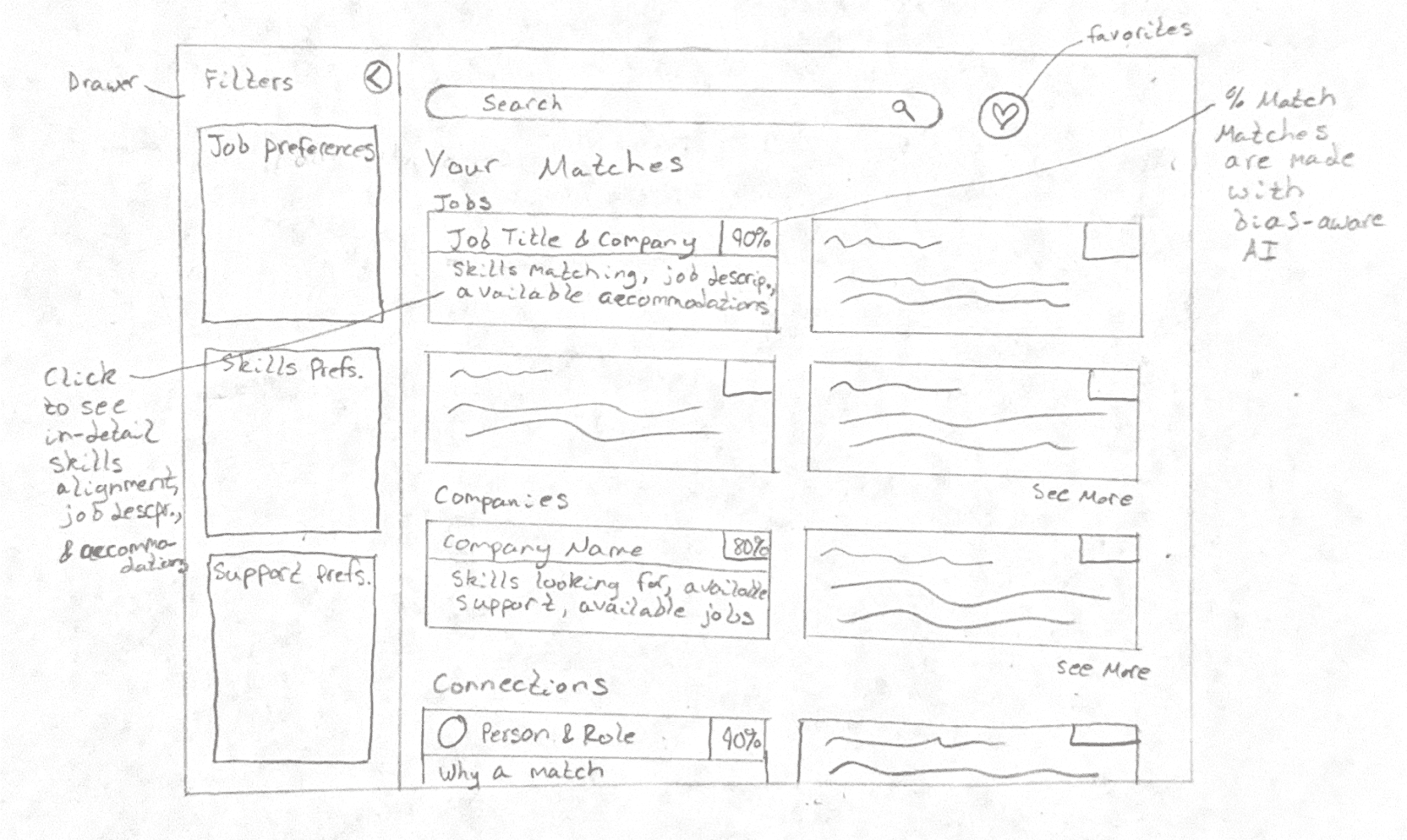
Transparent Company Profiles
The platform must allow users to quickly see company profiles that list accessibility scores, accommodations at various stages of employment, and hiring staff points of contact.

Wireframing
We created our wireframes in Figma while paying attention to the profile creation, job search, company profile pages.
Job Seeker Profile Creation
Key decisions included:
Prioritizing job experience and skills
Ability to self-describe disability
Resume upload auto-population feature
Enhanced accommodation options available

Job Search
Key decisions included:
Creating a simple yet informative interface.
Enabling enhanced filtering capability for:
Salary
Accommodations
Work type (Full-time, Part-time, and more)
Enhanced job listing information including:
Interview process information
Hiring staff points of contact
Company culture descriptions
Employer page links

Company Profile
We included the following key features based on our research:
Accessibility score with clear justification
Accessibility signifiers and certifications
Reviews from employees with disabilities
Link to company website
Access to hiring staff points of contact
Description of company culture

Prototyping and Usability Testing
We developed high-fidelity prototypes and conducted two rounds of moderated usability testing with seven total participants. Sessions were conducted remotely through Zoom and participants were asked to share their screen while following a "think-aloud" protocol. During the tests, the moderator presented the participant with three brief scenarios and three tasks to complete.
Accessible Usability Scale (AUS) Score
55 improved to 87
+58% Improved Average Score
Task Success
75% improved to 100%
+33% Improved Average Success Rate
Satisfaction (CSAT)
4.25 improved to 6.33
+2.08 Point Improved Average Score
Job Seeker Profile Creation
Problem
Creating a profile is a time-consuming, tedious, and insufficiently personalized process.
Solution
We gave users a quick and personalized profile creation process that allows people with disabilities to take control of how an employer views them.
User Feedback Adjustments
Allowing users to control if and when their disabilities and accommodations are shared with employers
Corrected fonts to be dyslexia friendly

Job Search
Problem
Searching, filtering, and being matched to the right jobs is a guessing game due to a lack of standardized job information transparency.
Solution
We created a simple, inclusively transparent, and skills-based job searching experience grounded in what our users actually said they want.
User Feedback Adjustments
Enhanced filtering capabilities for accommodations
Hoverable job matching justifications
Responsive employer indicator

Company Profile
Problem
Company culture and workplace accommodations are often unclear, misrepresented, or difficult to find.
Solution
We developed easily accessible employer profiles that allow users to quickly understand the overall accessibility, company culture, and accommodations offered by an company. We listened to our users desire for a human facing experience and made sure a job seeker can view past employee reviews and easily reach out to hiring staff.
User Feedback Adjustments
Enhanced accessibility scoring with clear justifications
Clear accommodation process information
Relevant employee reviews

Reflection & Implications
Every conversation we had with a person with a disability led us to a simple and yet concerning reality; accessibility is generally considered after a product is built. The key to our success in this project was building a platform where accessibility was the foundation, not a set of features added after. We were also reminded that accessibility is not a checklist, it must be informed by the genuine lived experiences of people with disabilities.
Small decisions and thoughtful planning had a big impact throughout our process. The massive jump in our AUS score averages didn't appear from an overhaul of the visual aesthetic or a daring new AI-enhanced feature. Instead, we intently listened to our users and incorporated their feedback, respecting them as collaborators to the project.
Overall, our team's work sets the stage for a new market of hiring features that are user-informed, transparent, inclusive, and accessible.